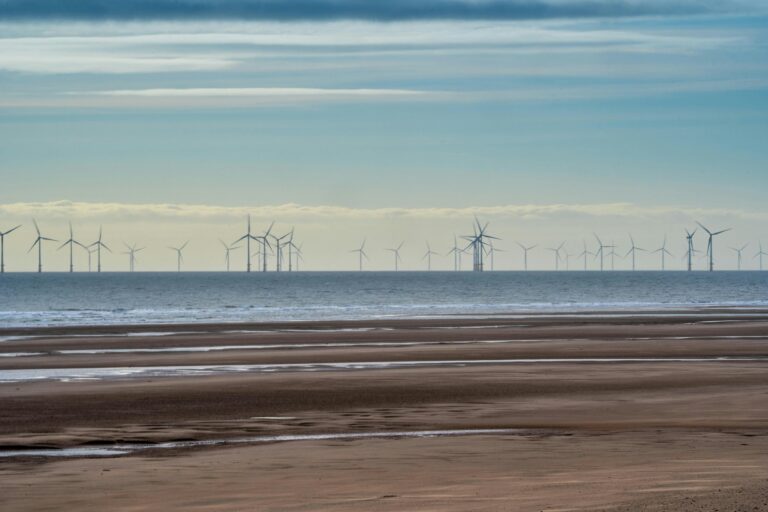
The Scottish Government’s decision to consent Ocean Winds’ 2 GW Caledonia development in the Moray Firth should have been an unambiguously good day for Scotland. It clears the last major planning hurdle from one of the largest ScotWind projects and, if it proceeds to construction, will bring £1.7 billion of Scottish spend, 140 turbines and long-term operational jobs to the north east.
However, buried in Ocean Winds’ own statement is a warning that perhaps should sit at the centre of every Scottish growth strategy: without reform of transmission charging, Caledonia and projects like it may never reach final investment. As Adam Morrison, Ocean Winds’ UK country manager, put it: “If the UK is serious about energy security, it needs Scottish offshore wind. And if it wants Scottish offshore wind at the lowest cost to consumer, it must fix TNUoS.”
The scale of the problem
Transmission Network Use of System charges are the annual fees generators pay to use Britain’s high-voltage grid. They are locational: the further you are from where power is consumed, the more you pay. In practice, this makes Scotland the most expensive place in Great Britain to generate electricity and southern England the cheapest.
The current numbers are stark. A generator in North Scotland pays around £26 per kilowatt of capacity per year, and in East Scotland £17. Along the English Channel and South Coast, generators receive a payment of £4 per kilowatt for the same service. A 1 GW Scottish offshore wind farm currently pays roughly £38 million a year to use the network; an identical wind farm off England’s south coast receives around £7 million. Transmission charging alone makes a Scottish offshore project around 20 per cent more expensive than an English one.
And it is getting worse. National Energy System Operator forecasts show TNUoS costs for parts of Scotland doubling by 2030. A 500 MW northern Scottish offshore wind farm could see annual charges rise from £13 million in 2025 to £27 million by the end of the decade. On Scottish Renewables’ analysis, offshore wind alone is set to absorb 57 per cent of the coming increase while accounting for only 24 per cent of installed capacity.
Why this matters for Contracts for Difference
Scottish offshore wind competes in the same UK-wide Contracts for Difference (CfD) auctions as projects off the east coast of England, the Irish Sea and the south. Every additional pound of transmission charge is a pound the developer must recover through the CfD strike price it bids. The wider tariff differential currently adds up to £17 per MWh to Scottish offshore wind CfD bids, and up to £27 per MWh once transmission losses are counted alongside.
That’s not a rounding-up error. In the most recent CfD round, Allocation Round 7, offshore wind projects in Scotland cleared at £89.49 per MWh in 2024 prices. Add another £17 per MWh of transmission cost on top of a project’s underlying LCOE and the arithmetic starts to fail: developers either bid too high to win, or win a contract that will not cover their costs and then cannot raise the debt to build. Scottish Government officials, in an internal briefing released this year under environmental information rules, put it plainly: “Transmission charges are collapsing project values in northern Scotland and eroding investor confidence.”
Where reform stands
The Ofgem review published in April, and the Charging Transitional Arrangements Group established in March under Ofgem’s reformed National Pricing programme, together mean reform is finally on the regulator’s agenda in a serious way. Ofgem’s preliminary view is that a single GB cap and floor on the £/kW Wider TNUoS charge is the most suitable intervention. That is the right direction. What it lacks is a timetable that matches investor need.
Caledonia is targeting offshore construction in 2030, which means a final investment decision in 2028 or 2029 and a successful CfD bid in 2027 or 2028. A cap-and-floor decision that lands in 2029 arrives after the investment case has already collapsed.
What Scotland stands to lose
Ocean Winds alone has committed £1.7 billion of Scottish spend if Caledonia proceeds, and its combined Moray Firth footprint would take long-term skilled operational jobs above 200. Multiply that across a 20 GW ScotWind pipeline and the Scottish supply-chain, port, cable-manufacturing and O&M workforce opportunity runs into five figures — before the induced effect on Scottish engineering, marine services and grid infrastructure.
But none of it is guaranteed by consent. Every one of those projects has to bank on a CfD auction that assumes a viable levelised cost of energy — and every one of them is being asked to price in the possibility that the biggest single line item in their operating cost base doubles between now and the end of the decade.
The ask is straightforward. Nobody is arguing for TNUoS to be abolished, and both the Scottish Government and developers accept that some locational signal is legitimate. What is being asked is a firm timetable for a cap on generator charges in Scotland, published early enough to be priced into the 2027 and 2028 CfD rounds.
Consent for Caledonia was a decision that was needed to support Scottish investment. But, the next decision — on TNUoS — is one the UK government needs to take. If it doesn’t, projects with consent in hand, £1.7 billion of committed spend behind them and a supply chain already gearing up in the north east may simply not get built.